CogniHoney Official Website › Blog › Ginkgo Powder Or Extract
Ginkgo Powder Is Not Ginkgo Extract: What The Big Trials Actually Gave People
Ginkgo is one of the best-known memory herbs on the shelf and one of the most thoroughly tested. The testing is the reason to read the CogniHoney line carefully: the list names ginkgo biloba powder, and the large trials gave people something else.
The short version
- Powder and extract differ. The trials used a standardised leaf extract; the CogniHoney list names ginkgo biloba powder.
- The big trial gave 120 mg twice a day. GEM followed 3,069 adults aged 75 and over for a median of 6.1 years.
- In healthy people, near zero. A meta-analysis found memory, executive and attention effects close to zero.
- The caution is real. Ginkgo may raise bleeding risk with blood thinners such as warfarin.
Two materials with one name
Ginkgo biloba is a tree, and the word ginkgo on a label can mean several different things. NCCIH notes that the leaf extract is the usual form in supplements and in research, and that fresh or roasted seeds and the crude plant have caused serious side effects. Which part of the tree, and how it was processed, matters.
A standardised extract is concentrated from the leaf and adjusted so each batch carries a set share of marker compounds. A powder is the dried plant material, ground. The two can come from the same tree and still behave as different ingredients, because the extract concentrates what the powder dilutes.
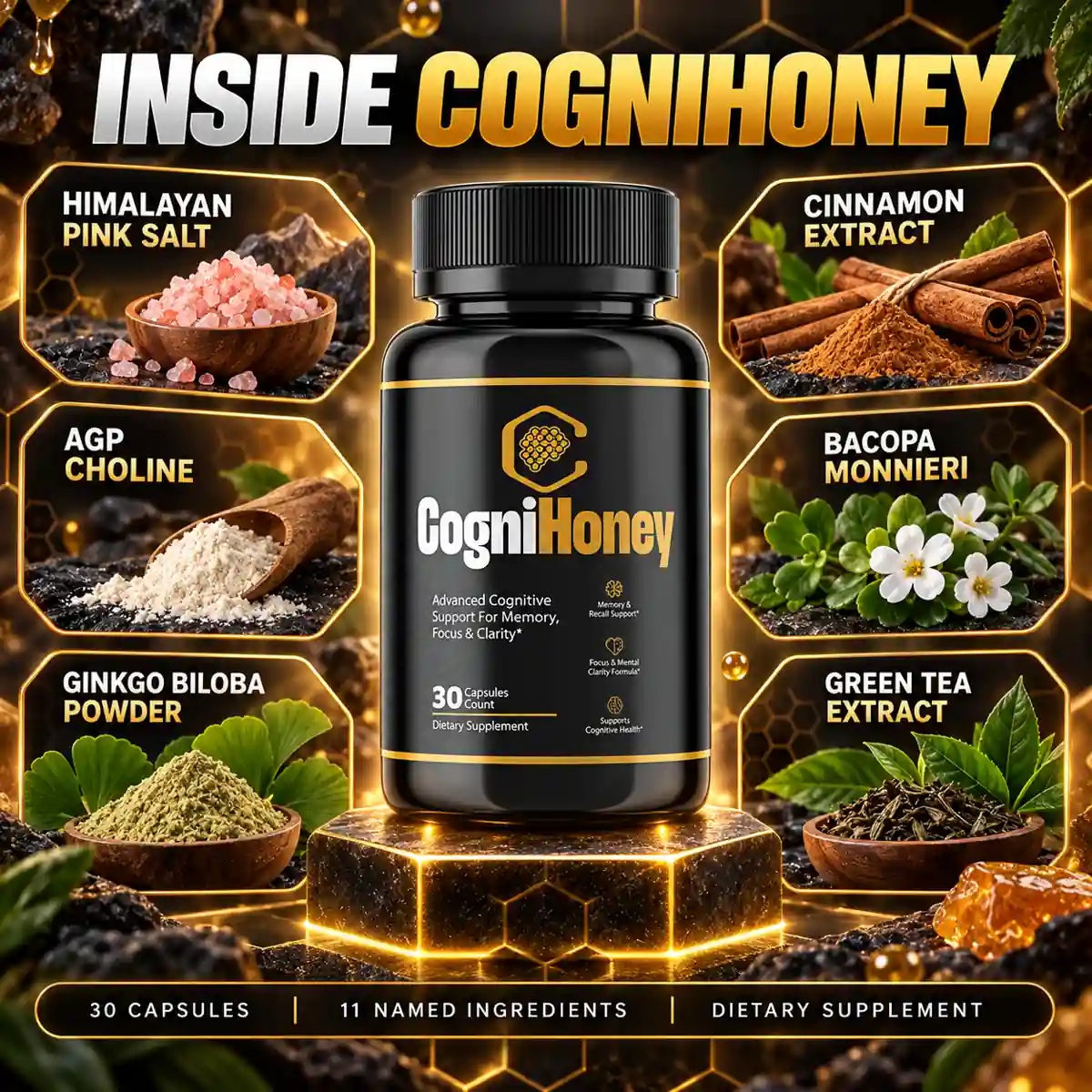
The CogniHoney list names ginkgo biloba powder. It gives no standardisation for it, unlike the bacopa, lutein, zeaxanthin and green tea lines, and it does not name the plant part. That is the single most important thing to know about the ginkgo in this capsule.
What the GEM trial gave people
The Ginkgo Evaluation of Memory trial is the largest of its kind. DeKosky 2008 randomised 3,069 adults aged 75 and over, with normal cognition or mild cognitive impairment, to 120 mg of standardised ginkgo extract twice a day or a placebo, and followed them for a median of 6.1 years. Ginkgo did not reduce the rate of dementia: the hazard ratio was 1.12, with a 95% confidence interval of 0.94 to 1.33.
A second analysis of the same trial, Snitz 2009, looked at cognitive decline rather than dementia. Rates of decline in memory, attention, language, visuospatial ability and executive function did not differ from placebo. This is an older population, cited here for its dose, its length and its null result, not as a picture of a healthy forty-year-old.
| Study | Who took part | Material and amount | Length | Result |
|---|---|---|---|---|
| GEM, DeKosky 2008 | 3,069 adults aged 75 and over | Standardised extract, 120 mg twice a day | Median 6.1 years | No reduction in dementia |
| GEM, Snitz 2009 | The same trial | The same extract and dose | Median 6.1 years | No slower cognitive decline in any domain |
| Laws 2012 | Healthy people, pooled trials | Various extracts and doses | Various | Effects close to zero, unrelated to dose or length |
| CogniHoney list | Adults 18 and over | Ginkgo biloba powder; the amount is on your bottle’s panel | Daily, two capsules | No trial of the formula is cited |
The last row is the label, not a study. The research rows describe what those trials gave, never what the capsule holds.
What standardisation means for ginkgo
Research ginkgo is not simply dried leaf. The extracts used in the large trials are standardised to set shares of two groups of marker compounds found in the leaf. That standardisation is what lets one trial’s extract be compared with the next, and it is what a dose in milligrams refers to.
A powder carries whatever the plant material happened to contain. It might be leaf, and it might be rich in the same compounds. A stated standardisation is what would let a reader compare it with 120 mg of a standardised extract, so the ginkgo line on the panel of the bottle you receive, and the form it names, is the one to read first.
CogniHoney on the official website
$49 to $79 a bottle, two capsules a day, 60 days from purchase to change your mind.
Check The Current PriceA note on what this is
CogniHoney is a dietary supplement, not a medicine. Nothing in this post describes it as a treatment for dementia, Alzheimer’s disease or mild cognitive impairment. Memory or thinking that is changing in a way that worries you, or a blood thinner or other prescription medicine, is a reason to show the bottle to your doctor before the first capsule.
In healthy people, close to zero
The question most buyers are actually asking is whether ginkgo sharpens a healthy memory. Laws 2012 pooled randomised trials in healthy people across three areas: memory, from 13 trials and 1,132 people; executive function; and attention. The effect sizes in all three were close to zero, and they did not grow with a higher dose or a longer trial.
That last detail matters. When an effect is real but small, it often shows up more clearly at higher doses or over longer periods. When it stays flat across both, the most likely reading is that there is little there to find in healthy people.
Why ginkgo is still on memory labels
Ginkgo has been sold for memory for decades, and it is one of the most familiar names in the category. Buyers look for it, and a label without it can look incomplete. That is a commercial reason, not an evidential one, and it is worth being clear about the difference.
In CogniHoney, ginkgo sits in the memory and focus core beside AGP choline and bacopa. Of the three, bacopa carries the most encouraging trial record, and the post on the four groups explains how the three fit together. Ginkgo’s place in the formula is better read as the familiar name than the load-bearing one.
There is a fair counterpoint. The meta-analysis and GEM tested ginkgo alone, and a formula combines it with ten other names. Nobody has tested this combination, so the research cannot say ginkgo adds nothing here; it can only say that, on its own, in healthy people, it has not shown much.
The blood-thinner caution
The part of the ginkgo story that is not in doubt is the caution. NCCIH notes that ginkgo may raise the risk of bleeding in people taking an anticoagulant such as warfarin, that its common side effects are dizziness, stomach upset and headache, and that it may be unsafe in pregnancy. CogniHoney is not for anyone who is pregnant or nursing in any case.
Interactions between supplements and medicines are easy to miss because supplements often go unmentioned at appointments. NCCIH’s guide to how they interact makes the practical point: tell every prescriber what you take, supplements included. For ginkgo, that conversation belongs before the first capsule, not after.
The safety page lists every interaction named for the eleven ingredients, with ginkgo first.
Five questions to ask of any ginkgo line
- Is it an extract or a powder?
- If it is an extract, what is it standardised to, and at what percentage?
- Which part of the plant is it from? The leaf is the studied part.
- How many milligrams does a serving hold, against the 120 mg twice a day GEM used?
- Do I take a blood thinner, or anything else that affects bleeding?
For CogniHoney, the first and third answers are on the list: powder, plant part unnamed. The second has no answer, because no standardisation is printed for the ginkgo. The fourth is on the panel of the bottle you receive. The fifth is yours, and it is the one that decides whether the capsule suits you at all.
A fair test of a formula with ginkgo in it
None of this means the CogniHoney capsule cannot be judged. It means the fair test is of the whole formula, over a sensible length of time, rather than of the ginkgo line on its own.
Note the purchase date. Give the routine the three to four weeks this desk’s buyers most often need before reporting a change, and look again at around day 50, with ten days of the sixty-day window still open. If nothing has changed by then, the guarantee exists for exactly that outcome, claimed by phone on +1 (302) 200-3480 with the order ID.
If something has changed, the honest reading is that the formula helped you, not that ginkgo did. The results timeline lays out the clocks, and the guarantee page explains how the window is counted.
Sources cited in this post
- National Center for Complementary and Integrative Health, National Institutes of Health. Ginkgo. https://www.nccih.nih.gov/health/ginkgo
- Laws KR, Sweetnam H, Kondel TK. Is Ginkgo biloba a cognitive enhancer in healthy individuals? A meta-analysis. Hum Psychopharmacol. 2012;27(6):527-33. PMID 23001963. https://pubmed.ncbi.nlm.nih.gov/23001963/
- DeKosky ST, Williamson JD, Fitzpatrick AL, Kronmal RA, Ives DG, Saxton JA, et al; Ginkgo Evaluation of Memory (GEM) Study Investigators. Ginkgo biloba for prevention of dementia: a randomized controlled trial. JAMA. 2008;300(19):2253-62. PMID 19017911. https://pubmed.ncbi.nlm.nih.gov/19017911/
- Snitz BE, O'Meara ES, Carlson MC, Arnold AM, Ives DG, Rapp SR, et al; Ginkgo Evaluation of Memory (GEM) Study Investigators. Ginkgo biloba for preventing cognitive decline in older adults: a randomized trial. JAMA. 2009;302(24):2663-70. PMID 20040554. https://pubmed.ncbi.nlm.nih.gov/20040554/
- National Center for Complementary and Integrative Health, National Institutes of Health. Know the Science: How Medications and Supplements Can Interact. https://www.nccih.nih.gov/health/know-science/how-medications-supplements-interact
Keep reading about CogniHoney
Read the CogniHoney panel, then decide
Ginkgo is one of eleven names. The capsule is two a day before your largest meal, with sixty days from purchase to change your mind.
$49 to $79 a bottle · two capsules a day, fifteen days a bottle · 60 days from purchase to change your mind
Order CogniHoney On The Official WebsiteLot COG-26/CO-7691 · checkout on the seller’s secure page