CogniHoney Official Website › Blog › Eleven Names, Four Jobs
CogniHoney Ingredients: Eleven Names, Four Jobs, Read as Groups
CogniHoney ingredients are eleven named items: Himalayan pink salt, cinnamon extract, AGP choline, bacopa monnieri (20%), lutein (5%), bilberry leaf powder, vitamin B6, ginkgo biloba powder, vitamin B12, zeaxanthin (5%) and green tea extract (50%). The seller’s list gives no milligram amounts. Read as groups, they form a memory and focus core, an eye-nutrient trio, two B vitamins and three pantry names.
The short version
- Four groups. A memory and focus core, an eye-nutrient trio, two B vitamins and three names from the kitchen shelf.
- One group carries the claims. AGP choline, bacopa and ginkgo sit closest to the label’s memory, focus and clarity claims.
- The evidence differs by group. Bacopa’s twelve-week trials are the most encouraging; ginkgo’s results in healthy people are close to zero.
- The panel decides the rest. The seller’s list gives no amounts, so each group’s strength depends on the panel on your bottle.
Why read a formula in groups
The seller’s list for CogniHoney names eleven ingredients: Himalayan pink salt, cinnamon extract, AGP choline, bacopa monnieri (20%), lutein (5%), bilberry leaf powder, vitamin B6, ginkgo biloba powder, vitamin B12, zeaxanthin (5%) and green tea extract (50%). Read top to bottom, that is a strange order. Salt comes first; the herb with the best memory research is fourth; two eye pigments are separated by a berry leaf and two vitamins.
A seller’s list is not a Supplement Facts panel, and nothing says this one is ranked by weight. So this desk reads it the other way: by what each name is there to do. Sorted that way, the eleven fall into four groups of two or three, and each group answers a different question a buyer might have.
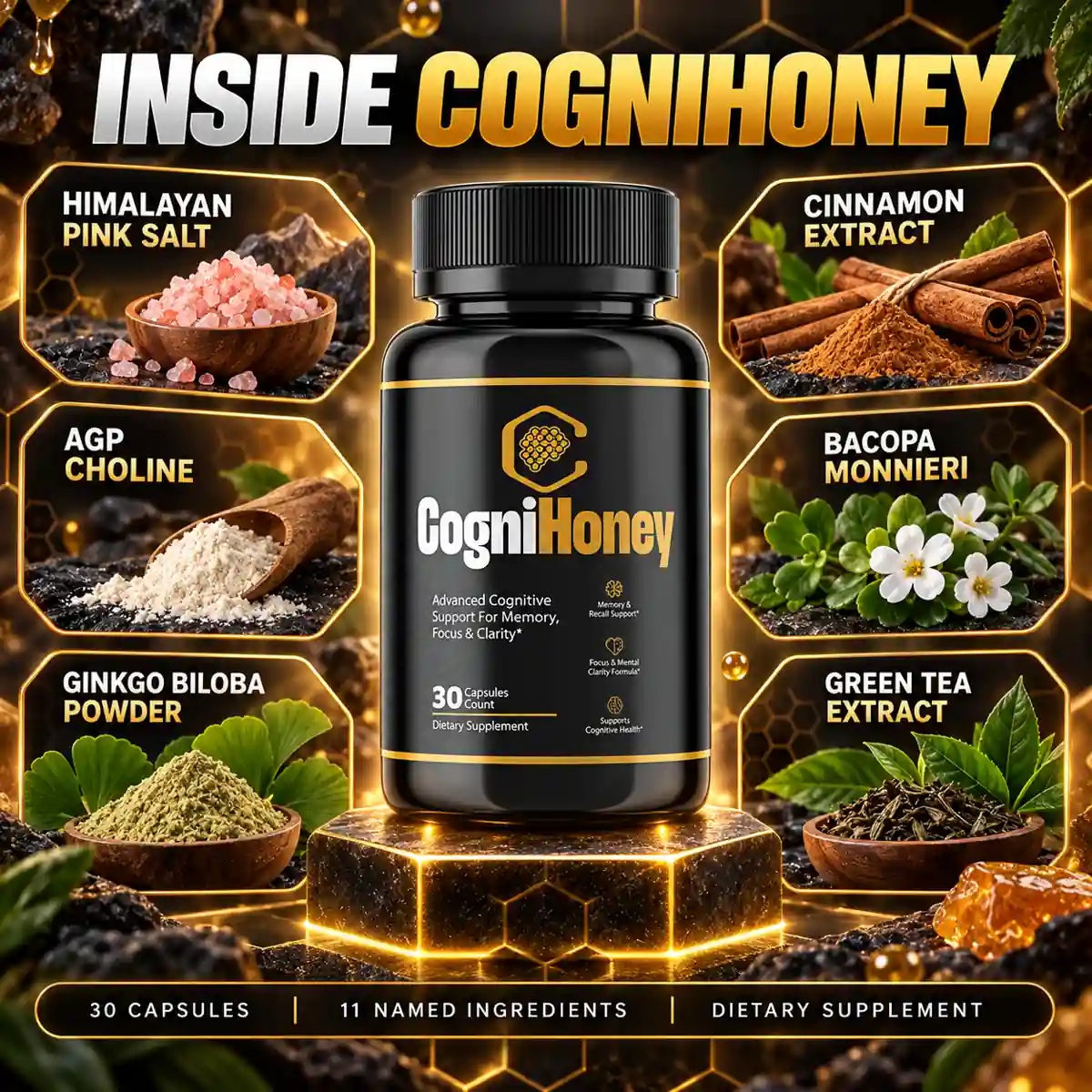
Grouping does not add a single milligram to anything. What it does is set expectations. A buyer who knows which three names carry the memory claims, and which three are there for other reasons, reads the rest of the label more calmly and asks better questions of it.
Group one: the memory and focus core
AGP choline, bacopa monnieri and ginkgo biloba are the three names most memory research is about, and they sit closest to the three claims on the label: memory and recall support, focus and mental clarity, and support for cognitive health.
AGP choline is alpha-GPC, a source of choline, which the body uses to make acetylcholine. In a 2024 crossover trial, single doses of 315 mg and 630 mg improved Stroop test scores an hour later in 20 healthy, resistance-trained men; two other attention tests did not change.
Bacopa monnieri has the most encouraging record of the three. Every trial in the 2012 systematic review ran twelve weeks at 300 to 450 mg of extract a day, in adults without dementia, and the clearest result was better memory free recall: nine of seventeen tests of it improved.
Ginkgo biloba is the sobering one. A 2012 meta-analysis of trials in healthy people found effects on memory, executive function and attention close to zero, and unrelated to dose or trial length. The CogniHoney list names it as a powder, which is a different material from the standardised extract those trials used.
Group two: the eye-nutrient trio
Lutein, zeaxanthin and bilberry leaf look out of place on a memory label until you know one fact: lutein and zeaxanthin are the yellow pigments of the macula, and they also collect in brain tissue. Researchers use the density of macular pigment as a marker of how much reaches the brain.
The trials are long and modest. A year-long trial gave 12 mg of lutein plus zeaxanthin a day to community-dwelling older adults and reported better complex attention and cognitive flexibility. The largest trial points the other way: AREDS2 gave 10 mg lutein and 2 mg zeaxanthin a day for five years to 3,501 older adults at risk of late macular degeneration and found no difference in cognitive scores.
Bilberry is a European relative of the blueberry, and most of its research uses the fruit. This list names the leaf, which is the detail in this group most worth a second look.
CogniHoney on the official website
$49 to $79 a bottle, two capsules a day, 60 days from purchase to change your mind.
Check The Current PriceA note on what this is
CogniHoney is a dietary supplement, not a medicine. Nothing in this post describes it as a treatment for dementia, Alzheimer’s disease or mild cognitive impairment. Memory or thinking that is changing in a way that worries you, or a blood thinner or other prescription medicine, is a reason to show the bottle to your doctor before the first capsule.
Group three: two B vitamins
Vitamin B6 and vitamin B12 are ordinary nutrients the nervous system uses every day. Adults need 1.3 to 1.7 mg of B6 and 2.4 mcg of B12 a day, and most people get both from food. B12 absorption falls with age and with some common medicines, which is why it appears on so many formulas for older buyers.
What the two vitamins do not do, on the evidence, is improve memory in people who already have enough of them. NCCIH sums up the trials plainly: short-term B6, B12 and folic acid have not been shown to improve cognitive function in older adults. Read this group as the formula’s nutrient floor, not its headline.
One practical point: B6 has an adult upper limit of 100 mg a day from food and supplements combined. If you already take a B-complex or a multivitamin, add the two together once your bottle’s panel shows the B6 amount.
Group four: the pantry trio
Himalayan pink salt, cinnamon extract and green tea extract are three names from the kitchen shelf. Two of them have no memory research behind them at all.
Pink salt is rock salt whose colour comes from small amounts of iron and other minerals; an analysis of 31 pink salts found a person would need more than 30 g a day for those minerals to matter, far more sodium than anyone should eat. In a capsule it is best read as a carrier. Cinnamon research is mostly about blood sugar in people with type 2 diabetes, and the list does not name the species.
Green tea extract, listed at 50%, is the exception. Green tea carries caffeine unless it is decaffeinated, and its clearest focus effects in the research come from caffeine and L-theanine acting together. The post on the serving direction takes this trio in full.
The four groups at a glance
Laid out as groups, the formula’s centre of gravity is plain: one herb with a real, modest record, one choline source with short trials, and a long tail of supporting names. The table sets the four side by side.
| Group | Names | What the research is about | Strength of what is cited |
|---|---|---|---|
| Memory and focus core | AGP choline, bacopa (20%), ginkgo powder | Attention, memory free recall, cognitive decline | Bacopa encouraging; alpha-GPC small and short; ginkgo near zero in healthy people |
| Eye-nutrient trio | Lutein (5%), zeaxanthin (5%), bilberry leaf | Macular pigment, attention and flexibility over a year | Two small positive trials, one large null |
| Two B vitamins | B6, B12 | Deficiency, nerve and blood health | No memory gain in older adults who are not deficient |
| Pantry trio | Pink salt, cinnamon, green tea (50%) | Sodium, blood sugar, caffeine with L-theanine | Only green tea has focus research |
Research figures describe single ingredients in the people each study enrolled. None is a statement about the CogniHoney capsule.
What the groups mean for your expectations
Each group runs on a different clock. The alpha-GPC trial measured an effect an hour after a single dose. The bacopa trials ran twelve weeks. The carotenoid trials ran a year or more. The B vitamins matter only if you were short of them to begin with, and the pantry trio is mostly there for other reasons.
That spread explains something in this desk’s own records: buyers most often report a change at three to four weeks, and the most common complaint is a slow start. A formula whose best-studied herb was tested over twelve weeks is not built to be judged in the first fortnight. The three-bottle pack lasts 45 days and the six-bottle pack 90; the pricing page sets them side by side.
The groups also tell you where to look first on the panel when your bottle arrives: the amounts of bacopa and AGP choline, then B6, then whether the green tea extract is decaffeinated. The ingredients page takes all eleven in turn, and the supplement facts page explains what the four percentages mean.
Four questions to bring to the panel
- How much bacopa is in a serving, and how does it compare with the 300 to 450 mg of extract a day the twelve-week trials used?
- How much AGP choline is in a serving, against the 315 to 630 mg single doses in the healthy-adult trial?
- How much vitamin B6, once added to any multivitamin or B-complex you already take?
- Is the green tea extract decaffeinated, and if not, how much caffeine does a serving carry?
Four questions, one for each group that has a number worth checking. The eye trio has a fifth, how much lutein and zeaxanthin, and the eye-nutrient post covers it.
Sources cited in this post
- Kerksick CM. Acute Alpha-Glycerylphosphorylcholine Supplementation Enhances Cognitive Performance in Healthy Men. Nutrients. 2024;16(23):4240. PMID 39683633. https://pubmed.ncbi.nlm.nih.gov/39683633/
- Pase MP, Kean J, Sarris J, Neale C, Scholey AB, Stough C. The cognitive-enhancing effects of Bacopa monnieri: a systematic review of randomized, controlled human clinical trials. J Altern Complement Med. 2012;18(7):647-52. PMID 22747190. https://pubmed.ncbi.nlm.nih.gov/22747190/
- Laws KR, Sweetnam H, Kondel TK. Is Ginkgo biloba a cognitive enhancer in healthy individuals? A meta-analysis. Hum Psychopharmacol. 2012;27(6):527-33. PMID 23001963. https://pubmed.ncbi.nlm.nih.gov/23001963/
- Hammond BR, Miller LS, Bello MO, Lindbergh CA, Mewborn C, Renzi-Hammond LM. Effects of Lutein/Zeaxanthin Supplementation on the Cognitive Function of Community Dwelling Older Adults: A Randomized, Double-Masked, Placebo-Controlled Trial. Front Aging Neurosci. 2017;9:254. PMID 28824416. https://pubmed.ncbi.nlm.nih.gov/28824416/
- Chew EY, Clemons TE, Agrón E, Launer LJ, Grodstein F, Bernstein PS; Age-Related Eye Disease Study 2 (AREDS2) Research Group. Effect of Omega-3 Fatty Acids, Lutein/Zeaxanthin, or Other Nutrient Supplementation on Cognitive Function: The AREDS2 Randomized Clinical Trial. JAMA. 2015;314(8):791-801. PMID 26305649. https://pubmed.ncbi.nlm.nih.gov/26305649/
- National Center for Complementary and Integrative Health, National Institutes of Health. 7 Things To Know About Dietary Supplements for Cognitive Function, Dementia, and Alzheimer's Disease. https://www.nccih.nih.gov/health/tips/things-to-know-about-dietary-supplements-for-cognitive-function-dementia-and-alzheimers-disease
Keep reading about CogniHoney
Try the four groups for yourself
Two capsules a day before your largest meal, fifteen days a bottle, and sixty days from purchase to change your mind.
$49 to $79 a bottle · two capsules a day, fifteen days a bottle · 60 days from purchase to change your mind
Order CogniHoney On The Official WebsiteLot COG-26/CO-7691 · checkout on the seller’s secure page