CogniHoney Official Website › Reference Guides › Choosing A Memory Supplement
Choosing A Memory Supplement: Ten Checks To Run On Any Label Before You Buy
Choose a memory supplement by reading the label, not the front of the box. Ten checks cover it: what the claim may say, the amount of each ingredient, what a percentage means, the form, who the research studied, how long it ran, interactions, upper limits, caffeine and timing, and whether the money-back window outlasts the time you need.
Below: the ten checks, the marketing red flags, and CogniHoney scored against them.
Why the label beats the front of the box
The front of a memory supplement is marketing: a brand, a promise in large type, a few ingredient names and a count. The label is a legal document. It has to carry the amount per serving of each dietary ingredient in a Supplement Facts panel, under 21 CFR 101.36, and any claim about how the product affects the body has to stay inside the limits of 21 CFR 101.93.
That makes the label the one place where two products can be compared on the same terms. It also means the most useful question to ask of any memory supplement is simple: does what the label says line up with what the published research actually tested?
A study result belongs to the ingredient, the amount, the form, the people and the time it was tested with.
The rule behind all ten checks
The one sentence to keep in mind
A study result belongs to the ingredient, the amount, the form, the people and the length of time it was tested with. Change any one of those and the result does not automatically travel with it.
Ten checks for any memory supplement label
Run them in order. The first three need only the label; the rest need the label and ten minutes with the sources.
- 01
The claim stays a structure/function claim
“Supports memory” is allowed with the FDA disclaimer; “treats memory loss” is a disease claim a supplement may not make. The FDA’s page on these claims draws the line.
- 02
Every ingredient has an amount
The panel should give milligrams or micrograms per serving. A name without an amount cannot be set against a trial dose.
- 03
A percentage is read as a standardisation
Bacopa 20% describes how concentrated the raw material is, not how much of it is in a capsule. Both numbers are needed.
- 04
The form matches the research
Ginkgo trials such as the GEM trial used 120 mg of standardised leaf extract twice a day; a powder is a different material. Bilberry research mostly uses the fruit, and NCCIH notes the leaf may be unsafe in high doses.
- 05
The population matches you
GEM enrolled adults aged 75 and over; AREDS2 enrolled older adults at risk of macular degeneration; the cinnamon meta-analysis pooled people with type 2 diabetes. None is a healthy forty-year-old.
- 06
The trial length matches your plan
Every trial in the 2012 bacopa review ran twelve weeks. A one-month trial of your own tests something else.
- 07
- 08
Upper limits are added up
Vitamin B6 has an adult upper limit of 100 mg a day from all sources (NIH ODS). A B-complex taken alongside counts toward it.
- 09
Caffeine and timing are clear
Green tea extract carries caffeine unless decaffeinated, and USP’s liver-safety review advises taking it with food, not on an empty stomach.
- 10
The guarantee outlasts the test
If the research ran twelve weeks and the refund window is sixty days, know which side of the window you will be deciding on.
Five phrases that should slow you down
None of them proves a product is poor. Each one is a reason to go back to the label.
“Clinically proven”
Ask: which trial, of which formula? Most memory products cite studies of single ingredients, which is a different thing.
“Reverses memory loss”
A disease claim. A dietary supplement may not make it, and a label that does is telling you something about the seller.
“Approved by the FDA”
The FDA does not approve supplements before sale. A registered facility is a listing, not an approval.
“Doctor recommended”, with no name
A seal that names no one cannot be checked, however reassuring the artwork.
“Results in days”
The ingredients with the best trial records were tested over weeks and months. Fast promises sit oddly against slow evidence.
What the FTC expects
The FTC’s health products guidance expects health claims in advertising to rest on competent and reliable scientific evidence, the same standard these checks apply.
CogniHoney scored against the ten checks
The same ten checks, applied to the capsule this website sells. It is allowed to lose points.
CogniHoney against the ten checks
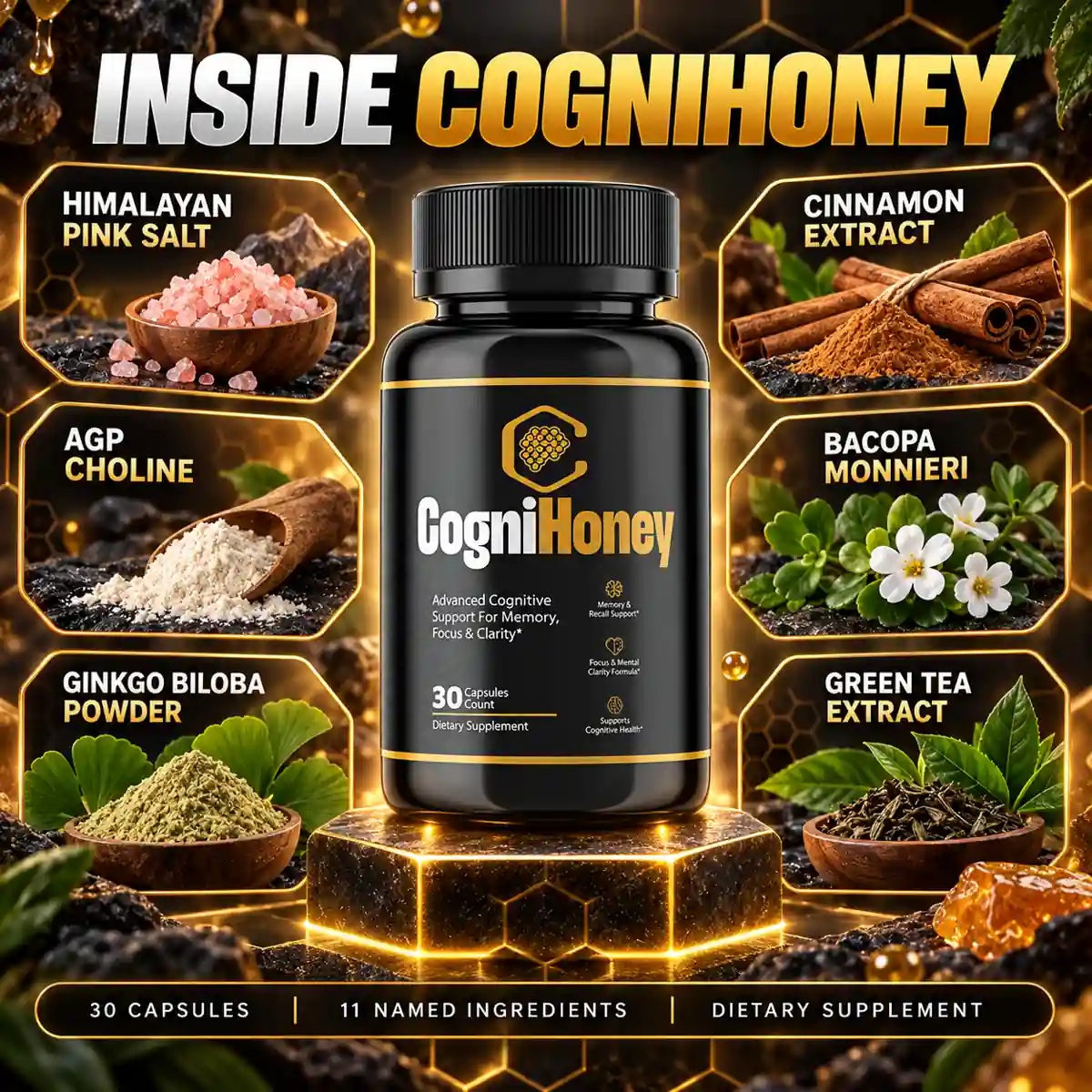
| 1. Claim | Passes: three structure/function claims, FDA statement on every page |
|---|---|
| 2. Amounts | Open: the seller’s list gives no milligram amounts; read the panel on your bottle |
| 3. Percentages | Partly: four of eleven names carry a standardisation, markers unnamed |
| 4. Form | Mixed: ginkgo listed as powder, bilberry as leaf |
| 5. Population | Answered per study on every ingredient page |
| 6. Trial length | Six bottles run 90 days, past a twelve-week trial; three run 45 |
| 7. Interactions | Named: ginkgo with warfarin, green tea with three medicines |
| 8. Upper limits | Check: contains B6; the amount is on the panel |
| 9. Caffeine and timing | Check: green tea extract, taken before the largest meal |
| 10. Guarantee | Passes: sixty days from purchase, by phone with the order ID |
| Overall | A clear routine, named interactions and a real guarantee; the amounts are the open question, and the panel on the bottle answers it |
A checklist passed on every line is written backwards
CogniHoney does well on the claim, the interactions and the guarantee. It leaves the most important number, the amount of each ingredient, to the panel on the bottle, and it lists two ingredients in a form the main research did not use. The supplement facts page and the ingredients page take each point further.
Questions to ask before you buy any memory supplement
Six questions a good seller can answer in writing.
When a supplement is the wrong tool
NCCIH’s seven things to know makes the point plainly: do not use a supplement as a reason to put off seeing a provider about memory loss. The National Institute on Aging covers what does help keep thinking sharp with age.
Choosing a memory supplement: quick answers
What should I look for first on a memory supplement label?
The Supplement Facts panel: the amount per serving of each ingredient. Without it you cannot compare the capsule with the amounts published studies used.
Is a standardised extract better than a powder?
Not automatically, but it is closer to what most trials tested. Ginkgo research, for example, uses standardised leaf extract, so a label listing ginkgo powder is describing a different material.
How long should I try a memory supplement?
Long enough to match the research behind its main ingredient. Every bacopa trial in the 2012 systematic review ran twelve weeks. Check that your pack and the guarantee window cover the time you intend to give it.
Can a supplement treat memory loss?
No supplement is approved to treat or prevent memory loss or dementia. A change in memory that worries you is a reason to be assessed, not a reason to start a capsule.
Who wrote this guide
Four claims about these pages that a sceptical reader can check in ten minutes.
-
01
The bottle is the source
The eleven names, the four percentages, the capsule count and the serving direction come from the product artwork and the seller’s own list. Prices, the guarantee and the refund steps come from the seller’s terms for this desk.
-
02
Research amounts live in a column of their own
Headed “What published studies used”, beside a column showing what the list gives. No sentence here moves a number from the first into the second.
-
03
Sources are cited against their own population
Where a study was run in people with a diagnosis, the sentence says so and the result is not carried across to a healthy reader.
-
04
Corrections change the date
Write to contact@Cognihhoney.com and the correction is made on the page itself, with the review date moved forward.
We earn when you buy
Cognihhoney is the USA Authorized CogniHoney Retailer and this website makes money on orders placed through it. That is why the unflattering parts are here too: the ingredients with thin evidence, the three-star review, and the plain statement that CogniHoney is not a treatment for anything. Tracking, changes and refunds go through +1 (302) 200-3480; orders go through the checkout only.
Sources cited in this guide
- Pase MP, Kean J, Sarris J, Neale C, Scholey AB, Stough C. The cognitive-enhancing effects of Bacopa monnieri: a systematic review of randomized, controlled human clinical trials. J Altern Complement Med. 2012;18(7):647-52. PMID 22747190. https://pubmed.ncbi.nlm.nih.gov/22747190/
- National Center for Complementary and Integrative Health, National Institutes of Health. Ginkgo. https://www.nccih.nih.gov/health/ginkgo
- Laws KR, Sweetnam H, Kondel TK. Is Ginkgo biloba a cognitive enhancer in healthy individuals? A meta-analysis. Hum Psychopharmacol. 2012;27(6):527-33. PMID 23001963. https://pubmed.ncbi.nlm.nih.gov/23001963/
- DeKosky ST, Williamson JD, Fitzpatrick AL, Kronmal RA, Ives DG, Saxton JA, et al; Ginkgo Evaluation of Memory (GEM) Study Investigators. Ginkgo biloba for prevention of dementia: a randomized controlled trial. JAMA. 2008;300(19):2253-62. PMID 19017911. https://pubmed.ncbi.nlm.nih.gov/19017911/
- Chew EY, Clemons TE, Agrón E, Launer LJ, Grodstein F, Bernstein PS; Age-Related Eye Disease Study 2 (AREDS2) Research Group. Effect of Omega-3 Fatty Acids, Lutein/Zeaxanthin, or Other Nutrient Supplementation on Cognitive Function: The AREDS2 Randomized Clinical Trial. JAMA. 2015;314(8):791-801. PMID 26305649. https://pubmed.ncbi.nlm.nih.gov/26305649/
- National Center for Complementary and Integrative Health, National Institutes of Health. Bilberry. https://www.nccih.nih.gov/health/bilberry
- NIH Office of Dietary Supplements. Vitamin B6: Fact Sheet for Health Professionals. https://ods.od.nih.gov/factsheets/VitaminB6-HealthProfessional/
- National Center for Complementary and Integrative Health, National Institutes of Health. 7 Things To Know About Dietary Supplements for Cognitive Function, Dementia, and Alzheimer's Disease. https://www.nccih.nih.gov/health/tips/things-to-know-about-dietary-supplements-for-cognitive-function-dementia-and-alzheimers-disease
- National Center for Complementary and Integrative Health, National Institutes of Health. Green Tea. https://www.nccih.nih.gov/health/green-tea
- Oketch-Rabah HA, Roe AL, Rider CV, Bonkovsky HL, Giancaspro GI, Navarro V, et al. United States Pharmacopeia (USP) comprehensive review of the hepatotoxicity of green tea extracts. Toxicol Rep. 2020;7:386-402. PMID 32140423. https://pubmed.ncbi.nlm.nih.gov/32140423/
- Allen RW, Schwartzman E, Baker WL, Coleman CI, Phung OJ. Cinnamon use in type 2 diabetes: an updated systematic review and meta-analysis. Ann Fam Med. 2013;11(5):452-9. PMID 24019277. https://pubmed.ncbi.nlm.nih.gov/24019277/
- National Institute on Aging, National Institutes of Health. Cognitive Health and Older Adults. https://www.nia.nih.gov/health/brain-health/cognitive-health-and-older-adults
- National Center for Complementary and Integrative Health, National Institutes of Health. Know the Science: How Medications and Supplements Can Interact. https://www.nccih.nih.gov/health/know-science/how-medications-supplements-interact
- Electronic Code of Federal Regulations. 21 CFR 101.36 - Nutrition labeling of dietary supplements. https://www.ecfr.gov/current/title-21/chapter-I/subchapter-B/part-101/subpart-C/section-101.36
- Electronic Code of Federal Regulations. 21 CFR 101.93 - Certain types of statements for dietary supplements. https://www.ecfr.gov/current/title-21/chapter-I/subchapter-B/part-101/subpart-F/section-101.93
- U.S. Food and Drug Administration. Structure/Function Claims. https://www.fda.gov/food/nutrition-food-labeling-and-critical-foods/structurefunction-claims
- Federal Trade Commission. Health Products Compliance Guidance. https://www.ftc.gov/business-guidance/resources/health-products-compliance-guidance
See how CogniHoney reads against the ten checks
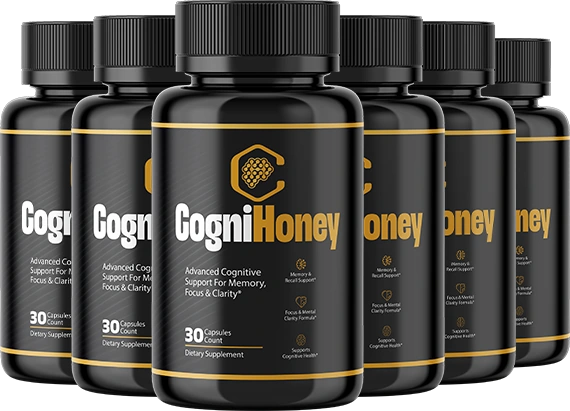
Eleven named ingredients, two capsules a day, and sixty days from purchase to change your mind.
$49 to $79 a bottle · two capsules a day, fifteen days a bottle · 60 days from purchase to change your mind
Order CogniHoney On The Official WebsiteLot COG-26/CO-7691 · checkout on the seller’s secure page