CogniHoney Official Website › How It Works
How Does CogniHoney Work? The Science Behind Each Group
CogniHoney works through its ingredients, as a daily routine judged over weeks.
AGP choline supplies choline, which the body uses to make acetylcholine, a messenger in attention and memory. Bacopa trials ran twelve weeks, and lutein and zeaxanthin build up over months.
For the full list, see all eleven ingredients.
The CogniHoney idea in three moves
Three kinds of ingredient, working to three different clocks.
- 01
Supply a building block
AGP choline is a source of choline, which the body turns into acetylcholine, a messenger for memory and attention (NIH ODS).
- 02
Build up over weeks
Bacopa and the two carotenoids are studied as daily habits, not single doses: twelve weeks for bacopa, twelve months for lutein and zeaxanthin.
- 03
Keep the basics covered
Vitamins B6 and B12 are everyday nutrients the nervous system uses. They sit in the formula as its floor, not its headline.
AGP choline: the CogniHoney acetylcholine ingredient
The one name on the list tied directly to a brain messenger, and the one whose short trials measured attention.
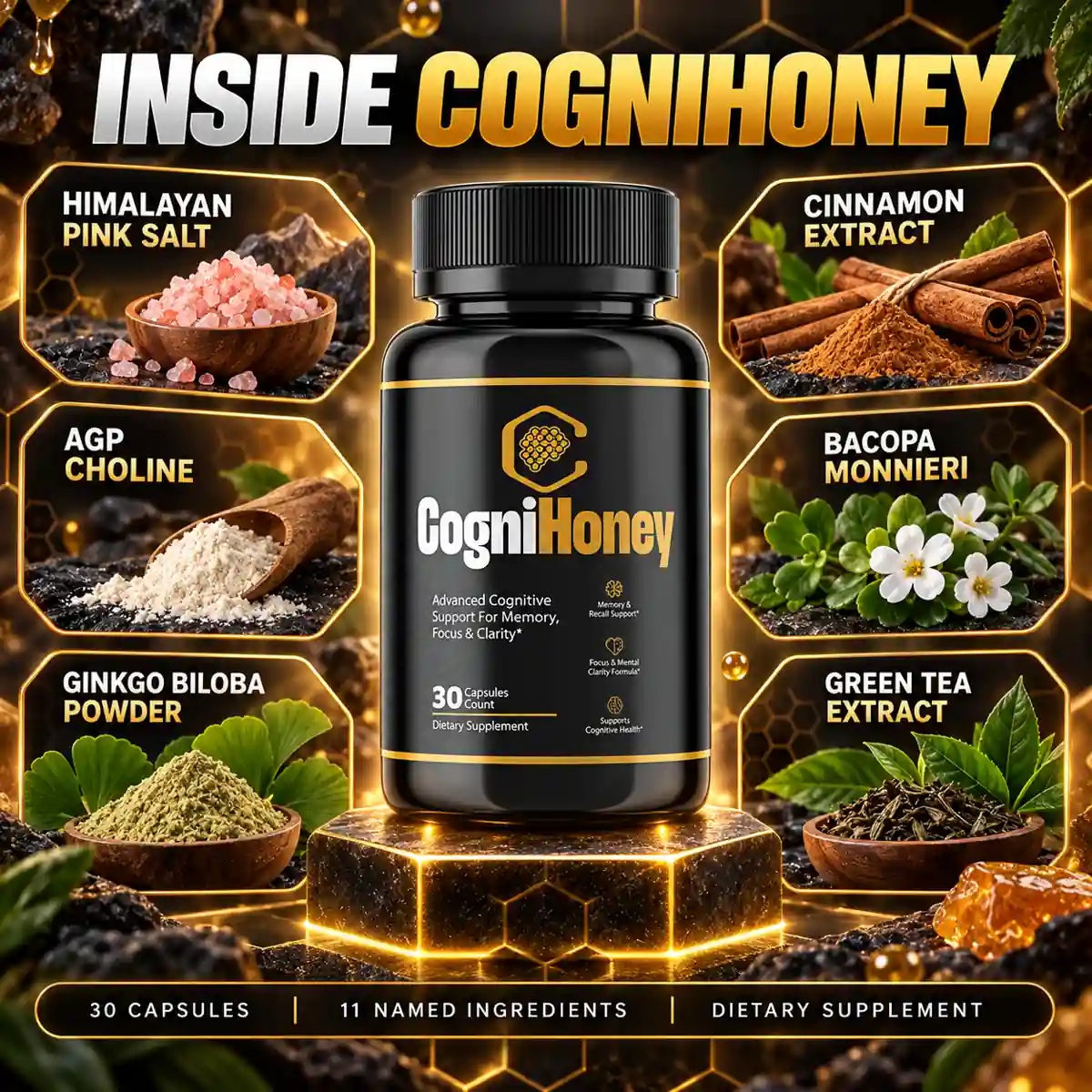
AGP choline is the label’s name for alpha-GPC, L-alpha-glycerylphosphorylcholine. Once absorbed it supplies choline, and choline is the raw material the body uses to make acetylcholine, a nerve messenger involved in memory, mood and muscle control. The NIH sets an Adequate Intake for choline of 550 mg a day for men and 425 mg for women (NIH Office of Dietary Supplements).
What the short trials measured
Choline is the raw material. Acetylcholine is the messenger.
The mechanism behind AGP choline, in one line
In a 2024 crossover trial of 20 healthy, resistance-trained men, single doses of 315 mg and 630 mg improved Stroop test scores an hour later, while the Flanker and N-Back tests did not change. A seven-day trial of 250 mg or 500 mg a day in 48 college-aged men found no difference on a psychomotor vigilance test, although blood choline rose.
The long-term picture is observational
Two large South Korean records studies point in opposite directions. The first, following more than 12 million adults aged 50 and over through national insurance data, found that people prescribed alpha-GPC had a higher ten-year risk of stroke. The second, in 508,107 patients newly diagnosed with mild cognitive impairment, found that users progressed to dementia less often. Neither is a trial, both followed prescription users, and neither population is a healthy adult buying a daily capsule.
Bacopa: why CogniHoney is a twelve-week question
Every bacopa trial worth citing ran for twelve weeks, and that single fact sets the pace for judging the whole formula.
The 2012 systematic review
Six randomised trials in adults without dementia, every one twelve weeks at 300 to 450 mg of extract a day. Bacopa improved 9 of 17 tests of memory free recall, with little evidence in other areas (Pase 2012).
The 2014 meta-analysis
Nine trials and 518 people taking a standardised extract for twelve weeks or more. The pooled result was faster Trail B and choice reaction times, read as speed of attention (Kongkeaw 2014).
Healthy adults, tested twice
A trial in healthy adults measured people at five and at twelve weeks; the largest effects on learning rate and memory consolidation came at twelve (Stough 2001).
Adults aged 65 and over
In 54 adults aged 65 and over, 300 mg a day for twelve weeks brought better delayed word recall and Stroop results. Side effects were mainly stomach upset, reported by 9 people on bacopa and 10 on placebo (Calabrese 2008).
What that means for a buyer
Bacopa is the ingredient on this list with the clearest trial record, and every one of those trials asked for twelve weeks of daily use. At two capsules a day, twelve weeks is 84 days: the six-bottle pack is the only one that covers it.
Lutein and zeaxanthin: the CogniHoney eye-to-brain link
The eye and the brain collect the same two yellow pigments, which is why eye nutrients appear on a memory label.
A marker you can measure
Lutein and zeaxanthin concentrate in the macula of the eye, and researchers use macular pigment as a marker of how much reaches brain tissue.
Older adults, one year
62 community-dwelling older adults took 12 mg of lutein plus zeaxanthin a day or placebo for a year; complex attention and cognitive flexibility improved (Hammond 2017).
Adults 18 to 30, one year
The same design in 51 healthy young adults improved spatial memory, reasoning and complex attention as macular pigment rose (Renzi-Hammond 2017).
The large null result
AREDS2 gave 10 mg lutein and 2 mg zeaxanthin a day for five years to 3,501 older adults at risk of late macular degeneration; cognitive change did not differ (Chew 2015).
Ginkgo in CogniHoney: the most studied, least proven name
Ginkgo has been tested at scale, and the scale is the reason to read its results carefully.
| Study | Who took part | What they took | What it found |
|---|---|---|---|
| Laws 2012 meta-analysis | Healthy people: 13 memory trials, 1,132 participants | Ginkgo extract at the doses each trial chose | Effects on memory, executive function and attention close to zero |
| GEM trial, DeKosky 2008 | 3,069 adults aged 75 and over, normal cognition or MCI | 120 mg of standardised extract twice a day, median 6.1 years | No reduction in dementia |
| GEM decline results, Snitz 2009 | The same older adults | The same dose | Rates of cognitive decline no different from placebo |
The CogniHoney supporting cast: B vitamins and the pantry trio
Five names that round out the formula, each with a smaller or different job from the core.
Where the CogniHoney mechanism story stops
The honest edge of the science, set out once.
Single ingredients, not the finished capsule
Every study cited here tested one ingredient, or a pair, at an amount its researchers chose. No published trial of the finished CogniHoney formula is cited on this website, and the list gives no amount for any of its eleven names, so no study’s result can be carried across to the capsule. What the research does give a buyer is a fair clock: weeks, not days.
What the research supports
- A clear mechanism for AGP choline: choline for acetylcholine
- Twelve-week trials showing better memory free recall with bacopa
- Year-long trials linking lutein and zeaxanthin with attention
- Everyday roles for B6 and B12 in the nervous system
What it cannot tell you
- How much of each ingredient a two-capsule serving holds
- Whether the eleven work together as a formula
- Any benefit from ginkgo in healthy people
- A change inside the first week
How CogniHoney works: common questions
How fast does CogniHoney work?
It is not a same-day product. This desk's buyers most often report a change at three to four weeks, and the bacopa trials behind the formula all ran twelve weeks.
Is CogniHoney a stimulant?
It is not sold as one. The only stimulant among the named ingredients is the caffeine that green tea extract carries unless it is decaffeinated.
Does CogniHoney work for everyone?
No supplement does. Results vary, and sleep, food and activity still matter. The sixty-day guarantee exists for the buyer it does not suit.
What does AGP choline mean on the CogniHoney list?
It is alpha-GPC, L-alpha-glycerylphosphorylcholine: a source of choline, which the body uses to make acetylcholine, a messenger involved in attention and memory. Search for alpha-GPC to find its research; AGP choline and choline alfoscerate are the same compound.
Why does a memory capsule like CogniHoney carry eye nutrients?
Lutein and zeaxanthin collect in the macula of the eye and in brain tissue, and researchers use macular pigment as a marker of how much reaches the brain. Year-long trials of 12 mg a day of the pair reported better complex attention in older adults and better spatial memory in adults aged 18 to 30.
Why is salt first on the CogniHoney list?
Himalayan pink salt has no memory research of its own. An Australian analysis of 31 pink salts found its trace minerals would only matter at more than 30 g a day, far more sodium than anyone should eat, so its place in a capsule is best read as a carrier.
Who writes the CogniHoney research pages
Four claims about these pages that a sceptical reader can check in ten minutes.
-
01
The bottle is the source
The eleven names, the four percentages, the capsule count and the serving direction come from the product artwork and the seller’s own list. Prices, the guarantee and the refund steps come from the seller’s terms for this desk.
-
02
Research amounts live in a column of their own
Headed “What published studies used”, beside a column showing what the list gives. No sentence here moves a number from the first into the second.
-
03
Sources are cited against their own population
Where a study was run in people with a diagnosis, the sentence says so and the result is not carried across to a healthy reader.
-
04
Corrections change the date
Write to contact@Cognihhoney.com and the correction is made on the page itself, with the review date moved forward.
We earn when you buy
Cognihhoney is the USA Authorized CogniHoney Retailer and this website makes money on orders placed through it. That is why the unflattering parts are here too: the ingredients with thin evidence, the three-star review, and the plain statement that CogniHoney is not a treatment for anything. Tracking, changes and refunds go through +1 (302) 200-3480; orders go through the checkout only.
CogniHoney research sources
- NIH Office of Dietary Supplements. Choline: Fact Sheet for Health Professionals. https://ods.od.nih.gov/factsheets/Choline-HealthProfessional/
- Kerksick CM. Acute Alpha-Glycerylphosphorylcholine Supplementation Enhances Cognitive Performance in Healthy Men. Nutrients. 2024;16(23):4240. PMID 39683633. https://pubmed.ncbi.nlm.nih.gov/39683633/
- Marcus L, Soileau J, Judge LW, Bellar D. Evaluation of the effects of two doses of alpha glycerylphosphorylcholine on physical and psychomotor performance. J Int Soc Sports Nutr. 2017;14:39. PMID 29042830. https://pubmed.ncbi.nlm.nih.gov/29042830/
- Lee G, Choi S, Chang J, Choi D, Son JS, Kim K, Kim SM, Jeong S, Park SM. Association of L-α Glycerylphosphorylcholine With Subsequent Stroke Risk After 10 Years. JAMA Netw Open. 2021;4(11):e2136008. PMID 34817582. https://pubmed.ncbi.nlm.nih.gov/34817582/
- Kim HK, Park S, Kim SW, Park ES, Hong JY, Hong I, Baek MS. Association between L-α glycerylphosphorylcholine use and delayed dementia conversion: A nationwide longitudinal study in South Korea. J Prev Alzheimers Dis. 2025;12(4):100059. PMID 40155153. https://pubmed.ncbi.nlm.nih.gov/40155153/
- Pase MP, Kean J, Sarris J, Neale C, Scholey AB, Stough C. The cognitive-enhancing effects of Bacopa monnieri: a systematic review of randomized, controlled human clinical trials. J Altern Complement Med. 2012;18(7):647-52. PMID 22747190. https://pubmed.ncbi.nlm.nih.gov/22747190/
- Kongkeaw C, Dilokthornsakul P, Thanarangsarit P, Limpeanchob N, Norman Scholfield C. Meta-analysis of randomized controlled trials on cognitive effects of Bacopa monnieri extract. J Ethnopharmacol. 2014;151(1):528-35. PMID 24252493. https://pubmed.ncbi.nlm.nih.gov/24252493/
- Calabrese C, Gregory WL, Leo M, Kraemer D, Bone K, Oken B. Effects of a standardized Bacopa monnieri extract on cognitive performance, anxiety, and depression in the elderly: a randomized, double-blind, placebo-controlled trial. J Altern Complement Med. 2008;14(6):707-13. PMID 18611150. https://pubmed.ncbi.nlm.nih.gov/18611150/
- Stough C, Lloyd J, Clarke J, Downey LA, Hutchison CW, Rodgers T, Nathan PJ. The chronic effects of an extract of Bacopa monniera (Brahmi) on cognitive function in healthy human subjects. Psychopharmacology (Berl). 2001;156(4):481-4. PMID 11498727. https://pubmed.ncbi.nlm.nih.gov/11498727/
- National Center for Complementary and Integrative Health, National Institutes of Health. Ginkgo. https://www.nccih.nih.gov/health/ginkgo
- Laws KR, Sweetnam H, Kondel TK. Is Ginkgo biloba a cognitive enhancer in healthy individuals? A meta-analysis. Hum Psychopharmacol. 2012;27(6):527-33. PMID 23001963. https://pubmed.ncbi.nlm.nih.gov/23001963/
- DeKosky ST, Williamson JD, Fitzpatrick AL, Kronmal RA, Ives DG, Saxton JA, et al; Ginkgo Evaluation of Memory (GEM) Study Investigators. Ginkgo biloba for prevention of dementia: a randomized controlled trial. JAMA. 2008;300(19):2253-62. PMID 19017911. https://pubmed.ncbi.nlm.nih.gov/19017911/
- Snitz BE, O'Meara ES, Carlson MC, Arnold AM, Ives DG, Rapp SR, et al; Ginkgo Evaluation of Memory (GEM) Study Investigators. Ginkgo biloba for preventing cognitive decline in older adults: a randomized trial. JAMA. 2009;302(24):2663-70. PMID 20040554. https://pubmed.ncbi.nlm.nih.gov/20040554/
- Hammond BR, Miller LS, Bello MO, Lindbergh CA, Mewborn C, Renzi-Hammond LM. Effects of Lutein/Zeaxanthin Supplementation on the Cognitive Function of Community Dwelling Older Adults: A Randomized, Double-Masked, Placebo-Controlled Trial. Front Aging Neurosci. 2017;9:254. PMID 28824416. https://pubmed.ncbi.nlm.nih.gov/28824416/
- Renzi-Hammond LM, Bovier ER, Fletcher LM, Miller LS, Mewborn CM, Lindbergh CA, Baxter JH, Hammond BR. Effects of a Lutein and Zeaxanthin Intervention on Cognitive Function: A Randomized, Double-Masked, Placebo-Controlled Trial of Younger Healthy Adults. Nutrients. 2017;9(11):1246. PMID 29135938. https://pubmed.ncbi.nlm.nih.gov/29135938/
- Chew EY, Clemons TE, Agrón E, Launer LJ, Grodstein F, Bernstein PS; Age-Related Eye Disease Study 2 (AREDS2) Research Group. Effect of Omega-3 Fatty Acids, Lutein/Zeaxanthin, or Other Nutrient Supplementation on Cognitive Function: The AREDS2 Randomized Clinical Trial. JAMA. 2015;314(8):791-801. PMID 26305649. https://pubmed.ncbi.nlm.nih.gov/26305649/
- NIH Office of Dietary Supplements. Vitamin B6: Fact Sheet for Health Professionals. https://ods.od.nih.gov/factsheets/VitaminB6-HealthProfessional/
- NIH Office of Dietary Supplements. Vitamin B12: Fact Sheet for Health Professionals. https://ods.od.nih.gov/factsheets/VitaminB12-HealthProfessional/
- National Center for Complementary and Integrative Health, National Institutes of Health. 7 Things To Know About Dietary Supplements for Cognitive Function, Dementia, and Alzheimer's Disease. https://www.nccih.nih.gov/health/tips/things-to-know-about-dietary-supplements-for-cognitive-function-dementia-and-alzheimers-disease
- Mancini E, Beglinger C, Drewe J, Zanchi D, Lang UE, Borgwardt S. Green tea effects on cognition, mood and human brain function: A systematic review. Phytomedicine. 2017;34:26-37. PMID 28899506. https://pubmed.ncbi.nlm.nih.gov/28899506/
- National Center for Complementary and Integrative Health, National Institutes of Health. Cinnamon. https://www.nccih.nih.gov/health/cinnamon
- Allen RW, Schwartzman E, Baker WL, Coleman CI, Phung OJ. Cinnamon use in type 2 diabetes: an updated systematic review and meta-analysis. Ann Fam Med. 2013;11(5):452-9. PMID 24019277. https://pubmed.ncbi.nlm.nih.gov/24019277/
- Fayet-Moore F, Wibisono C, Carr P, Duve E, Petocz P, Lancaster G, McMillan J, Marshall S, Blumfield M. An Analysis of the Mineral Composition of Pink Salt Available in Australia. Foods. 2020;9(10):1490. PMID 33086585. https://pubmed.ncbi.nlm.nih.gov/33086585/
Try CogniHoney for yourself
Two capsules a day, fifteen days a bottle, and sixty days from purchase to ask for your money back. Orders go through the seller's secure checkout.
$49 to $79 a bottle · two capsules a day, fifteen days a bottle · 60 days from purchase to change your mind
Order CogniHoney On The Official WebsiteLot COG-26/CO-7691 · checkout on the seller’s secure page