CogniHoney Official Website › Supplement Facts
CogniHoney Supplement Facts: The Label, Line by Line
Each CogniHoney bottle holds 30 capsules, and the serving is two capsules a day.
The list names eleven ingredients, four with a printed percentage: bacopa 20%, lutein 5%, zeaxanthin 5% and green tea extract 50%. A bottle lasts fifteen days.
To learn what each one does, see the ingredients.
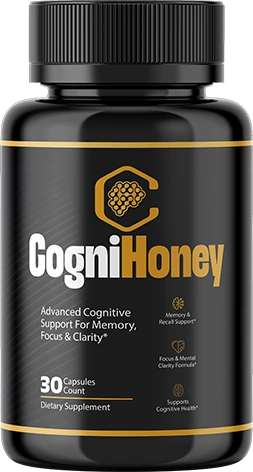
What the CogniHoney bottle front prints
Seven lines, read off the bottle artwork as printed, with what each one tells a buyer.
| Printed line | What it tells you |
|---|---|
| CogniHoney | The brand name. Honey is not an ingredient; the honeycomb is artwork. |
| Advanced Cognitive Support For Memory, Focus & Clarity | The one-line description, naming the three areas the claims cover. |
| Memory & Recall Support | The first of three claim icons. |
| Focus & Mental Clarity Formula | The second claim icon. |
| Supports Cognitive Health | The third claim icon. |
| 30 Capsules Count | Thirty capsules: fifteen days at two a day. |
| Dietary Supplement | The legal category: sold under supplement rules, with no FDA approval before sale. |
The eleven CogniHoney ingredients as the list prints them
The list in the seller’s order, with the group each name belongs to on this website.
| # | As listed | What it is | Group | Printed figure |
|---|---|---|---|---|
| 1 | Himalayan pink salt | Mineral salt | The pantry trio | – |
| 2 | Cinnamon extract | Bark extract | The pantry trio | – |
| 3 | AGP choline | Choline compound | The memory and focus core | – |
| 4 | Bacopa monnieri (20%) | Herb extract | The memory and focus core | 20% |
| 5 | Lutein (5%) | Carotenoid | The eye-nutrient trio | 5% |
| 6 | Bilberry leaf powder | Leaf powder | The eye-nutrient trio | – |
| 7 | Vitamin B6 | Vitamin | Two B vitamins | – |
| 8 | Ginkgo biloba powder | Leaf powder | The memory and focus core | – |
| 9 | Vitamin B12 | Vitamin | Two B vitamins | – |
| 10 | Zeaxanthin (5%) | Carotenoid | The eye-nutrient trio | 5% |
| 11 | Green tea extract (50%) | Leaf extract | The pantry trio | 50% |
Each name has its own card, research and sources on the ingredients page.
CogniHoney label analysis: amounts, and where to find them
This is the one place this website sets out what the list leaves open, and how to close the gap yourself.
The list names eleven ingredients and prints four percentages, but it gives no amount in milligrams or micrograms for any of them. This website reproduces only what it can read and check, so it prints no panel of its own and never estimates an amount.
On a supplement bottle, the Supplement Facts panel is where amounts live. Under 21 CFR 101.36, the panel gives a serving size and the amount per serving of each dietary ingredient, or, where ingredients sit in a proprietary blend, the blend’s total weight with its ingredients listed in descending order of weight.
What to do with that
Read the panel on the bottle you receive. If it shows amounts, set them against the research column in the table below. If it shows a proprietary blend, the order of names inside it tells you which is present in the largest quantity.
| Ingredient, as listed | What published studies used | What the CogniHoney list gives |
|---|---|---|
| AGP choline | 315 mg and 630 mg single doses (healthy men); 250 mg and 500 mg a day for 7 days | Named, no amount |
| Bacopa monnieri (20%) | 300 to 450 mg of extract a day, every trial twelve weeks | 20% standardisation, no amount |
| Ginkgo biloba powder | 120 mg of standardised leaf extract twice a day; near-zero effect in healthy people | Powder, plant part and amount not given |
| Lutein (5%) and zeaxanthin (5%) | 12 mg a day combined for a year; 10 mg + 2 mg a day for five years in AREDS2 | 5% standardisation each, no amount |
| Bilberry leaf powder | Fruit extracts up to 160 mg a day for six months; leaf not well studied | Leaf powder, no amount |
| Vitamin B6 | Adult RDA 1.3 to 1.7 mg; upper limit 100 mg a day from all sources | Named, no amount |
| Vitamin B12 | Adult RDA 2.4 mcg; no upper limit set | Named, no amount |
| Green tea extract (50%) | Studied as tea or extract with caffeine and L-theanine; liver reports at 140 to 1,000 mg EGCG a day | 50% standardisation, no amount |
| Cinnamon extract | 120 mg to 6 g a day in type 2 diabetes trials; studied for blood sugar, not memory | Species and amount not given |
| Himalayan pink salt | No memory research; more than 30 g a day needed for its minerals to matter | Named, no amount |
Column two comes from the studies cited here. None of it is the amount in a CogniHoney capsule, and no number moves from column two to column three.
What this means for a buyer
Treat the research column as context for your own bottle’s panel, never as the capsule’s contents. The ingredient with the most encouraging record, bacopa, was tested at 300 to 450 mg of extract a day for twelve weeks; whether a two-capsule serving reaches that is a question only the panel can answer.
The four CogniHoney percentages, read correctly
Four of the eleven names carry a figure. None of the four is a dose.
A percentage is a concentration
A percentage beside an ingredient name is normally a standardisation figure: the share of a marker compound in that raw material. The list does not name the markers, so the four figures say how concentrated each material is, never how much of it is in a capsule.
Bacopa monnieri, 20%
Bacopa extracts are commonly standardised to their bacosides, the compounds most bacopa research measures. The 20% describes how concentrated the extract is.
Lutein, 5%
Lutein raw materials are sold at different strengths. The 5% describes the material; the trials cited on this website counted lutein in milligrams, a different measure.
Zeaxanthin, 5%
Read it exactly as the lutein figure. The two share a printed strength, which matches how research gives them: together, as a pair.
Green tea extract, 50%
Green tea extracts are usually standardised to their catechins or polyphenols. Caffeine is a separate matter: it comes with green tea unless decaffeinated.
The CogniHoney serving, in numbers
The serving direction and the arithmetic that follows from it.
How to read the CogniHoney panel on your bottle
Four checks, in the order the label is laid out, then one look at the base. Two minutes, once.
- 01
Find the serving size
It should read two capsules, matching the serving direction. Every amount on the panel is per serving.
- 02
Read the amounts
Look for a figure beside each of the eleven names, or for a proprietary blend with one total weight.
- 03
Check the order in any blend
Inside a proprietary blend, names run from most to least by weight, so the first name is the largest.
- 04
Read the other ingredients
The capsule shell and any fillers are listed below the panel. This is where a vegetarian buyer checks the shell.
Then turn the bottle over
When the bottle shows them, the lot and best-before date are printed on the base. Note both beside your order ID. This desk’s lot reference is COG-26/CO-7691; to match a bottle to an order, call +1 (302) 200-3480.
The CogniHoney label claims and the rules behind them
Three claim icons, and the two federal rules that decide what they are allowed to say.
CogniHoney label questions
Where is the CogniHoney Supplement Facts panel?
US labelling rules require one on a supplement’s label, giving the serving size and the amount per serving of each dietary ingredient (21 CFR 101.36). Read it on the bottle you receive; this website reproduces only what it can check.
How many milligrams of bacopa are in CogniHoney?
The list prints bacopa at 20% and gives no milligram figure. The bacopa trials used 300 to 450 mg of extract a day; the panel on your bottle is where the capsule’s own amount appears.
Is CogniHoney vegetarian and gluten free?
None of the eleven names is a gluten grain or a dairy ingredient, and the seller shows Vegetarian and Naturally Gluten Free seals with the product. The capsule shell is listed under other ingredients on the panel; check it there if that matters to you.
What does Dietary Supplement on the CogniHoney label mean?
It is sold under supplement rules: no FDA approval before sale, structure/function claims only, and the FDA disclaimer beside them.
Who reads the CogniHoney label for this website
Four claims about these pages that a sceptical reader can check in ten minutes.
-
01
The bottle is the source
The eleven names, the four percentages, the capsule count and the serving direction come from the product artwork and the seller’s own list. Prices, the guarantee and the refund steps come from the seller’s terms for this desk.
-
02
Research amounts live in a column of their own
Headed “What published studies used”, beside a column showing what the list gives. No sentence here moves a number from the first into the second.
-
03
Sources are cited against their own population
Where a study was run in people with a diagnosis, the sentence says so and the result is not carried across to a healthy reader.
-
04
Corrections change the date
Write to contact@Cognihhoney.com and the correction is made on the page itself, with the review date moved forward.
We earn when you buy
Cognihhoney is the USA Authorized CogniHoney Retailer and this website makes money on orders placed through it. That is why the unflattering parts are here too: the ingredients with thin evidence, the three-star review, and the plain statement that CogniHoney is not a treatment for anything. Tracking, changes and refunds go through +1 (302) 200-3480; orders go through the checkout only.
CogniHoney label sources
- Kerksick CM. Acute Alpha-Glycerylphosphorylcholine Supplementation Enhances Cognitive Performance in Healthy Men. Nutrients. 2024;16(23):4240. PMID 39683633. https://pubmed.ncbi.nlm.nih.gov/39683633/
- Marcus L, Soileau J, Judge LW, Bellar D. Evaluation of the effects of two doses of alpha glycerylphosphorylcholine on physical and psychomotor performance. J Int Soc Sports Nutr. 2017;14:39. PMID 29042830. https://pubmed.ncbi.nlm.nih.gov/29042830/
- Pase MP, Kean J, Sarris J, Neale C, Scholey AB, Stough C. The cognitive-enhancing effects of Bacopa monnieri: a systematic review of randomized, controlled human clinical trials. J Altern Complement Med. 2012;18(7):647-52. PMID 22747190. https://pubmed.ncbi.nlm.nih.gov/22747190/
- Calabrese C, Gregory WL, Leo M, Kraemer D, Bone K, Oken B. Effects of a standardized Bacopa monnieri extract on cognitive performance, anxiety, and depression in the elderly: a randomized, double-blind, placebo-controlled trial. J Altern Complement Med. 2008;14(6):707-13. PMID 18611150. https://pubmed.ncbi.nlm.nih.gov/18611150/
- Laws KR, Sweetnam H, Kondel TK. Is Ginkgo biloba a cognitive enhancer in healthy individuals? A meta-analysis. Hum Psychopharmacol. 2012;27(6):527-33. PMID 23001963. https://pubmed.ncbi.nlm.nih.gov/23001963/
- DeKosky ST, Williamson JD, Fitzpatrick AL, Kronmal RA, Ives DG, Saxton JA, et al; Ginkgo Evaluation of Memory (GEM) Study Investigators. Ginkgo biloba for prevention of dementia: a randomized controlled trial. JAMA. 2008;300(19):2253-62. PMID 19017911. https://pubmed.ncbi.nlm.nih.gov/19017911/
- Hammond BR, Miller LS, Bello MO, Lindbergh CA, Mewborn C, Renzi-Hammond LM. Effects of Lutein/Zeaxanthin Supplementation on the Cognitive Function of Community Dwelling Older Adults: A Randomized, Double-Masked, Placebo-Controlled Trial. Front Aging Neurosci. 2017;9:254. PMID 28824416. https://pubmed.ncbi.nlm.nih.gov/28824416/
- Chew EY, Clemons TE, Agrón E, Launer LJ, Grodstein F, Bernstein PS; Age-Related Eye Disease Study 2 (AREDS2) Research Group. Effect of Omega-3 Fatty Acids, Lutein/Zeaxanthin, or Other Nutrient Supplementation on Cognitive Function: The AREDS2 Randomized Clinical Trial. JAMA. 2015;314(8):791-801. PMID 26305649. https://pubmed.ncbi.nlm.nih.gov/26305649/
- National Center for Complementary and Integrative Health, National Institutes of Health. Bilberry. https://www.nccih.nih.gov/health/bilberry
- NIH Office of Dietary Supplements. Vitamin B6: Fact Sheet for Health Professionals. https://ods.od.nih.gov/factsheets/VitaminB6-HealthProfessional/
- NIH Office of Dietary Supplements. Vitamin B12: Fact Sheet for Health Professionals. https://ods.od.nih.gov/factsheets/VitaminB12-HealthProfessional/
- Mancini E, Beglinger C, Drewe J, Zanchi D, Lang UE, Borgwardt S. Green tea effects on cognition, mood and human brain function: A systematic review. Phytomedicine. 2017;34:26-37. PMID 28899506. https://pubmed.ncbi.nlm.nih.gov/28899506/
- Oketch-Rabah HA, Roe AL, Rider CV, Bonkovsky HL, Giancaspro GI, Navarro V, et al. United States Pharmacopeia (USP) comprehensive review of the hepatotoxicity of green tea extracts. Toxicol Rep. 2020;7:386-402. PMID 32140423. https://pubmed.ncbi.nlm.nih.gov/32140423/
- National Center for Complementary and Integrative Health, National Institutes of Health. Cinnamon. https://www.nccih.nih.gov/health/cinnamon
- Allen RW, Schwartzman E, Baker WL, Coleman CI, Phung OJ. Cinnamon use in type 2 diabetes: an updated systematic review and meta-analysis. Ann Fam Med. 2013;11(5):452-9. PMID 24019277. https://pubmed.ncbi.nlm.nih.gov/24019277/
- Fayet-Moore F, Wibisono C, Carr P, Duve E, Petocz P, Lancaster G, McMillan J, Marshall S, Blumfield M. An Analysis of the Mineral Composition of Pink Salt Available in Australia. Foods. 2020;9(10):1490. PMID 33086585. https://pubmed.ncbi.nlm.nih.gov/33086585/
- U.S. Food and Drug Administration. Questions and Answers on Dietary Supplements. https://www.fda.gov/food/information-consumers-using-dietary-supplements/questions-and-answers-dietary-supplements
- Electronic Code of Federal Regulations. 21 CFR 101.36 - Nutrition labeling of dietary supplements. https://www.ecfr.gov/current/title-21/chapter-I/subchapter-B/part-101/subpart-C/section-101.36
- Electronic Code of Federal Regulations. 21 CFR 101.93 - Certain types of statements for dietary supplements. https://www.ecfr.gov/current/title-21/chapter-I/subchapter-B/part-101/subpart-F/section-101.93
- U.S. Food and Drug Administration. Structure/Function Claims. https://www.fda.gov/food/nutrition-food-labeling-and-critical-foods/structurefunction-claims
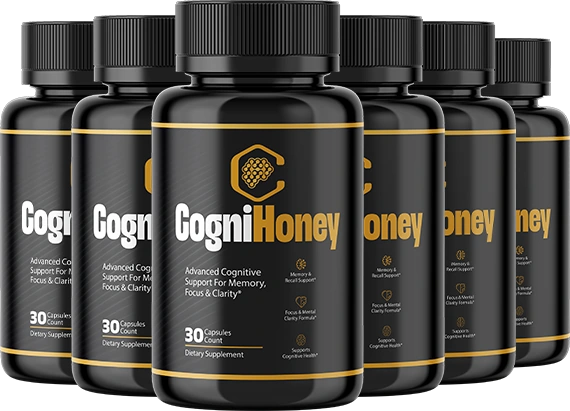
Order CogniHoney and read the panel yourself
Two capsules a day, fifteen days a bottle, and sixty days from purchase to ask for your money back. Orders go through the seller's secure checkout.
$49 to $79 a bottle · two capsules a day, fifteen days a bottle · 60 days from purchase to change your mind
Order CogniHoney On The Official WebsiteLot COG-26/CO-7691 · checkout on the seller’s secure page