CogniHoney Official Website › Blog › Before Your Largest Meal
Before Your Largest Meal: Pink Salt, Cinnamon And Green Tea In A Focus Capsule
The CogniHoney serving direction is specific: two capsules with a full glass of water, 30 to 60 minutes before your largest meal. Three names on the list come from the kitchen shelf, and one of them carries a caution about exactly that kind of timing.
The short version
- The direction. Two capsules daily with a full glass of water, 30 to 60 minutes before the largest meal.
- Two pantry names have no memory research. Pink salt and cinnamon are there for other reasons.
- Green tea is the exception. Its clearest focus effects come from caffeine and L-theanine together.
- One caution to weigh. USP advises taking green tea extract with food, not on an empty stomach.
The serving direction, word for word
The seller gives one serving direction: two capsules daily with a full glass of water, about 30 to 60 minutes before your largest meal. At two capsules a day, a 30-capsule bottle lasts fifteen days.
Anchoring a supplement to a meal is a practical choice as much as anything else. A meal you eat every day is a reliable cue, and a routine that sticks is what this desk’s five-star reviewers wrote about most: the daily habit stuck and they reordered before the last bottle. The direction does not explain why before rather than with the meal, and this post does not invent a reason.
What it does raise is a question about one ingredient, green tea extract, which a major safety review suggests taking with food. That question is the last section of this post. First, the three names it belongs to.
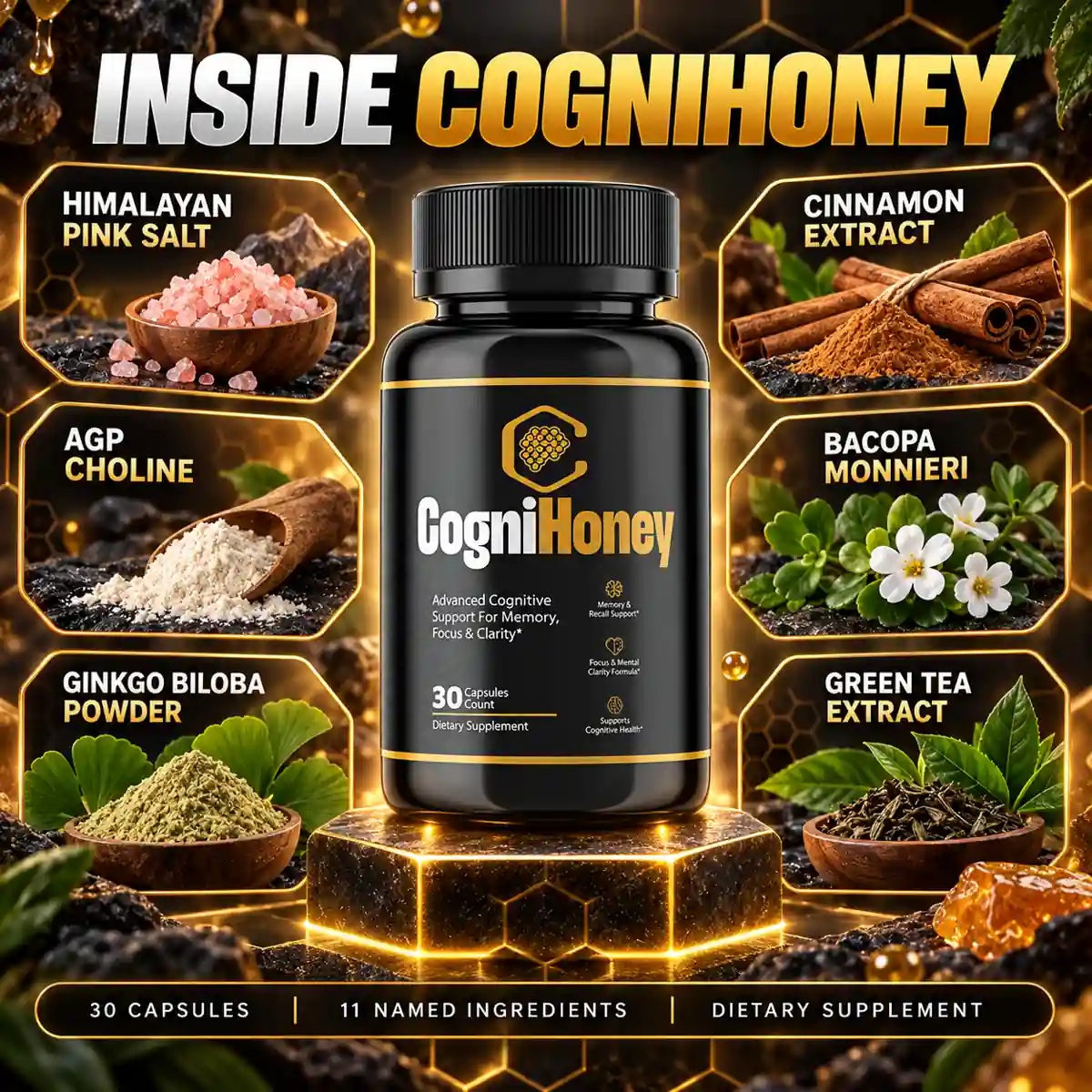
Himalayan pink salt: first on the list
Himalayan pink salt is rock salt whose colour comes from small amounts of iron and other minerals. It is sodium chloride with traces. An Australian analysis of 31 pink salts found that a person would need more than 30 g a day, about six teaspoons, for those trace minerals to contribute meaningfully, which would be an excessive amount of sodium.
For scale, the FDA advises adults to keep sodium under 2,300 mg a day, about one teaspoon of salt, and notes that Americans average about 3,400 mg. A capsule holds a fraction of a gram of everything combined, so whatever the salt amount, it is small beside a day’s food. It has no memory research of its own, and in a capsule it is best read as a carrier.
Cinnamon extract: the species goes unnamed
Cinnamon comes from two main groups of trees, Ceylon and cassia. NCCIH notes that cassia is the most common kind in North America and carries coumarin, a compound linked to liver problems in sensitive people, that products often do not say which species they use, and that research does not clearly support cinnamon for any condition.
Most cinnamon research is about blood sugar in people with type 2 diabetes, not memory. The CogniHoney list names cinnamon extract without a species. If you have a liver condition, that is a line to look at on the panel and to raise with your prescriber.
Ceylon cinnamon is often sold as true cinnamon and carries far less coumarin. A label that names Cinnamomum verum or Ceylon is telling you which one it used; a label that says only cinnamon, as this one does, leaves the question open, and the panel on the bottle may or may not answer it.
CogniHoney on the official website
$49 to $79 a bottle, two capsules a day, 60 days from purchase to change your mind.
Check The Current PriceA note on what this is
CogniHoney is a dietary supplement, not a medicine. Nothing in this post describes it as a treatment for dementia, Alzheimer’s disease or mild cognitive impairment. Memory or thinking that is changing in a way that worries you, or a blood thinner or other prescription medicine, is a reason to show the bottle to your doctor before the first capsule.
Green tea extract: the one with a focus record
Green tea extract, listed at 50%, is the pantry name with genuine attention research. A 2017 systematic review of 21 studies found the clearest effects on memory and attention under the combined influence of caffeine and L-theanine, and less with either alone.
That puts caffeine at the centre of the question. Green tea contains caffeine unless it is decaffeinated (NCCIH), and that is what makes the evening timing worth a closer look. The 50% normally describes the share of a marker compound in the extract, a measure of how concentrated it is. If caffeine affects your sleep or blood pressure, the panel on your bottle is the place to check.
NCCIH also lists the extract’s reported side effects, nausea, constipation, abdominal discomfort and raised blood pressure, and notes that green tea has lowered blood levels of the medicines nadolol and atorvastatin and interacts with raloxifene.
The three pantry names side by side
Two of the three are there for reasons other than memory. The third is there for focus, and it is also the one whose timing deserves a closer look.
| Name as listed | What it is | What its research is about | Worth knowing |
|---|---|---|---|
| Himalayan pink salt | Rock salt with trace minerals | Mineral content; no memory research | Over 30 g a day needed for its minerals to matter |
| Cinnamon extract | Bark extract, species unnamed | Blood sugar in type 2 diabetes | Cassia carries coumarin; liver caution |
| Green tea extract (50%) | Leaf extract, marker unnamed | Attention and memory with caffeine and L-theanine | Caffeine unless decaffeinated; USP advises taking it with food |
Research topics and cautions for each ingredient in general. The capsule’s own amounts for all three are on the panel of the bottle you receive.
Caffeine, sleep and an evening meal
For many people the largest meal of the day is dinner. Taken 30 to 60 minutes before it, the capsules land in the early evening, and green tea extract carries caffeine unless it is decaffeinated. The list gives no caffeine figure, so nobody can say from the list alone whether that matters.
The practical answer is to watch for it. If you are sensitive to caffeine and your sleep changes in the first week, that is worth noticing, and a lunch that is your largest meal is an equally valid anchor for the same direction. Sleep matters for focus and memory in its own right, and a routine that costs sleep is working against itself.
Before a meal, or with food?
Liver injury has been reported with concentrated green tea extracts, mostly in capsule or tablet form. The United States Pharmacopeia review of those reports found cases at EGCG intakes from 140 mg to about 1,000 mg a day, noted that bolus doses taken fasting raise the absorption of the tea’s catechins, and set a caution for labels: do not take on an empty stomach; take with food.
The CogniHoney direction places the capsules 30 to 60 minutes before the largest meal. Whether that counts as an empty stomach depends on when you last ate, and neither the seller nor this post can decide that for you. Both statements are set side by side here so that you can.
Two practical readings are reasonable. If you have ever had a liver problem, read the green tea line on your bottle’s panel first and talk to your prescriber before you start. If you have not, and the capsules sit well, the direction on the label is the one to follow; do not take more than it states.
The how to use page walks through the routine step by step, and the safety page sets the green tea caution beside every other named interaction.
Making the routine stick
- Pick the meal that is reliably your largest, and keep to it on most days.
- Keep the bottle where you will see it before that meal, with a glass for the water.
- Take two capsules, no more, 30 to 60 minutes before you eat.
- Write the purchase date on the first bottle, and look again at three to four weeks and at day 50.
- If a bottle runs out before the next arrives, carry on when it does; do not double up.
Five small habits. Together they are most of what separates a fair trial of a daily capsule from an interrupted one, and the reviewers who liked CogniHoney most wrote about the habit before anything else. Two capsules a day empties a bottle every fifteen days, so even the two-bottle pack runs out within a month, and a larger pack also removes a gap in the routine.
Sources cited in this post
- National Center for Complementary and Integrative Health, National Institutes of Health. Green Tea. https://www.nccih.nih.gov/health/green-tea
- Mancini E, Beglinger C, Drewe J, Zanchi D, Lang UE, Borgwardt S. Green tea effects on cognition, mood and human brain function: A systematic review. Phytomedicine. 2017;34:26-37. PMID 28899506. https://pubmed.ncbi.nlm.nih.gov/28899506/
- Oketch-Rabah HA, Roe AL, Rider CV, Bonkovsky HL, Giancaspro GI, Navarro V, et al. United States Pharmacopeia (USP) comprehensive review of the hepatotoxicity of green tea extracts. Toxicol Rep. 2020;7:386-402. PMID 32140423. https://pubmed.ncbi.nlm.nih.gov/32140423/
- National Center for Complementary and Integrative Health, National Institutes of Health. Cinnamon. https://www.nccih.nih.gov/health/cinnamon
- Fayet-Moore F, Wibisono C, Carr P, Duve E, Petocz P, Lancaster G, McMillan J, Marshall S, Blumfield M. An Analysis of the Mineral Composition of Pink Salt Available in Australia. Foods. 2020;9(10):1490. PMID 33086585. https://pubmed.ncbi.nlm.nih.gov/33086585/
- U.S. Food and Drug Administration. Sodium in Your Diet. https://www.fda.gov/food/nutrition-education-resources-materials/sodium-your-diet
Keep reading about CogniHoney
Start the CogniHoney routine with your largest meal
Two capsules with a full glass of water, 30 to 60 minutes before it. Fifteen days a bottle, sixty days from purchase to change your mind.
$49 to $79 a bottle · two capsules a day, fifteen days a bottle · 60 days from purchase to change your mind
Order CogniHoney On The Official WebsiteLot COG-26/CO-7691 · checkout on the seller’s secure page