CogniHoney Official Website › Blog › AGP Choline, Three Names
AGP Choline, Alpha-GPC, Choline Alfoscerate: One Ingredient, Three Names
AGP choline is an unusual way to write one of the best-known ingredients in the memory category. Under its other names it has short trials in healthy adults and two huge Korean studies that point in opposite directions, and a careful buyer should see all of it.
The short version
- One molecule. AGP choline, alpha-GPC and choline alfoscerate are L-alpha-glycerylphosphorylcholine.
- A choline source. Choline is used to make acetylcholine; adults need 425 to 550 mg a day from all sources.
- Short trials in healthy men. Single doses of 315 and 630 mg improved one attention test an hour later; two others did not change.
- Two cohorts, two directions. One linked prescription use with more strokes, the other with slower progression to dementia.
Three names, one molecule
The full chemical name is L-alpha-glycerylphosphorylcholine. In the U.S. supplement trade it is usually shortened to alpha-GPC. In parts of Europe and Asia it is prescribed as a medicine under the name choline alfoscerate. The CogniHoney list calls it AGP choline, which is the same substance under a less common abbreviation.
Knowing the names matters for one practical reason: if you already take a product listing alpha-GPC, the AGP choline in CogniHoney is more of the same thing, not something new.
| Name | Where you usually see it |
|---|---|
| L-alpha-glycerylphosphorylcholine | Scientific papers and titles |
| Alpha-GPC | U.S. supplement labels and sports nutrition |
| Choline alfoscerate | Prescription use, including the Korean studies below |
| AGP choline | The CogniHoney ingredient list |
All four names describe the same compound.
What choline does, and how much adults need
Choline is a nutrient the body uses to build cell membranes and to make acetylcholine, a messenger involved in memory, mood and muscle control. The NIH fact sheet on choline sets the Adequate Intake at 550 mg a day for men and 425 mg for women, with a Daily Value of 550 mg. Eggs, meat, fish and some beans are rich sources.
Alpha-GPC is one of several forms in which choline is sold as a supplement. The same fact sheet also sets an upper limit for adults of 3,500 mg of choline a day from all sources, far above what a capsule formula is likely to add, but worth knowing if you stack several choline products.
Why the acetylcholine story is only a starting point
The appeal of a choline source on a memory label is easy to state: choline is a building block of acetylcholine, and acetylcholine is involved in attention and memory. It is a sound piece of biology and a weak piece of evidence, because supplying a building block does not show that more of the finished messenger is made, or that thinking changes if it is.
That is why the trials matter more than the mechanism. They skip the chain of reasoning and measure the outcome directly: give people alpha-GPC or a dummy capsule, then test them. The results are the part of the story a buyer can actually lean on, and they are small and specific.
CogniHoney on the official website
$49 to $79 a bottle, two capsules a day, 60 days from purchase to change your mind.
Check The Current PriceA note on what this is
CogniHoney is a dietary supplement, not a medicine. Nothing in this post describes it as a treatment for dementia, Alzheimer’s disease or mild cognitive impairment. Memory or thinking that is changing in a way that worries you, or a blood thinner or other prescription medicine, is a reason to show the bottle to your doctor before the first capsule.
The trials in healthy adults
The healthy-adult trials of alpha-GPC are small and short. Kerksick 2024 gave single doses of 315 mg and 630 mg alpha-GPC, or a placebo, in a crossover design to 20 resistance-trained men averaging 31 years. Stroop test scores improved at both doses an hour later; the Flanker and N-Back tests did not differ.
Marcus 2017 gave 250 mg or 500 mg a day for seven days, against 200 mg of caffeine or a placebo, to 48 college-aged men. There was no difference on the psychomotor vigilance test. Blood choline rose, and the 500 mg group showed lower thyroid-stimulating hormone.
| Study | Design and people | Amount | What it found |
|---|---|---|---|
| Kerksick 2024 | Crossover, 20 resistance-trained men | 315 mg or 630 mg, one dose | Stroop improved an hour later; Flanker and N-Back did not |
| Marcus 2017 | 48 college-aged men, 7 days | 250 mg or 500 mg a day | No vigilance difference; blood choline rose |
| Lee 2021 | Cohort, 12,008,977 adults aged 50 and over | Prescription use | Higher ten-year stroke risk in users |
| Kim 2025 | Cohort, 508,107 people newly diagnosed with MCI | Prescription use | Lower risk of progressing to dementia |
Research amounts only, from the studies named. The CogniHoney amount of AGP choline is on the panel of the bottle you receive.
Two Korean cohorts pointing in opposite directions
The largest studies of this ingredient are not trials at all. They come from South Korea’s national health insurance records, where choline alfoscerate is prescribed. Lee 2021 followed 12,008,977 adults aged 50 and over, of whom 108,877 were prescribed it between 2006 and 2008, through to 2018. After matching, users had a higher risk of total stroke (adjusted hazard ratio 1.43, 95% confidence interval 1.41 to 1.46), and the risk rose with longer use.
Kim 2025 looked at 508,107 patients newly diagnosed with mild cognitive impairment between 2013 and 2016. Those prescribed it had a lower risk of progressing to Alzheimer’s dementia (hazard ratio 0.899) and to vascular dementia (0.832).
Both are observational: they follow people who were prescribed the drug, and people who are prescribed something differ from people who are not in ways no adjustment fully captures. The second was in a diagnosed population. Neither tested a supplement capsule in healthy adults. They are cited together so that neither is read alone.
Reading AGP choline on the CogniHoney list
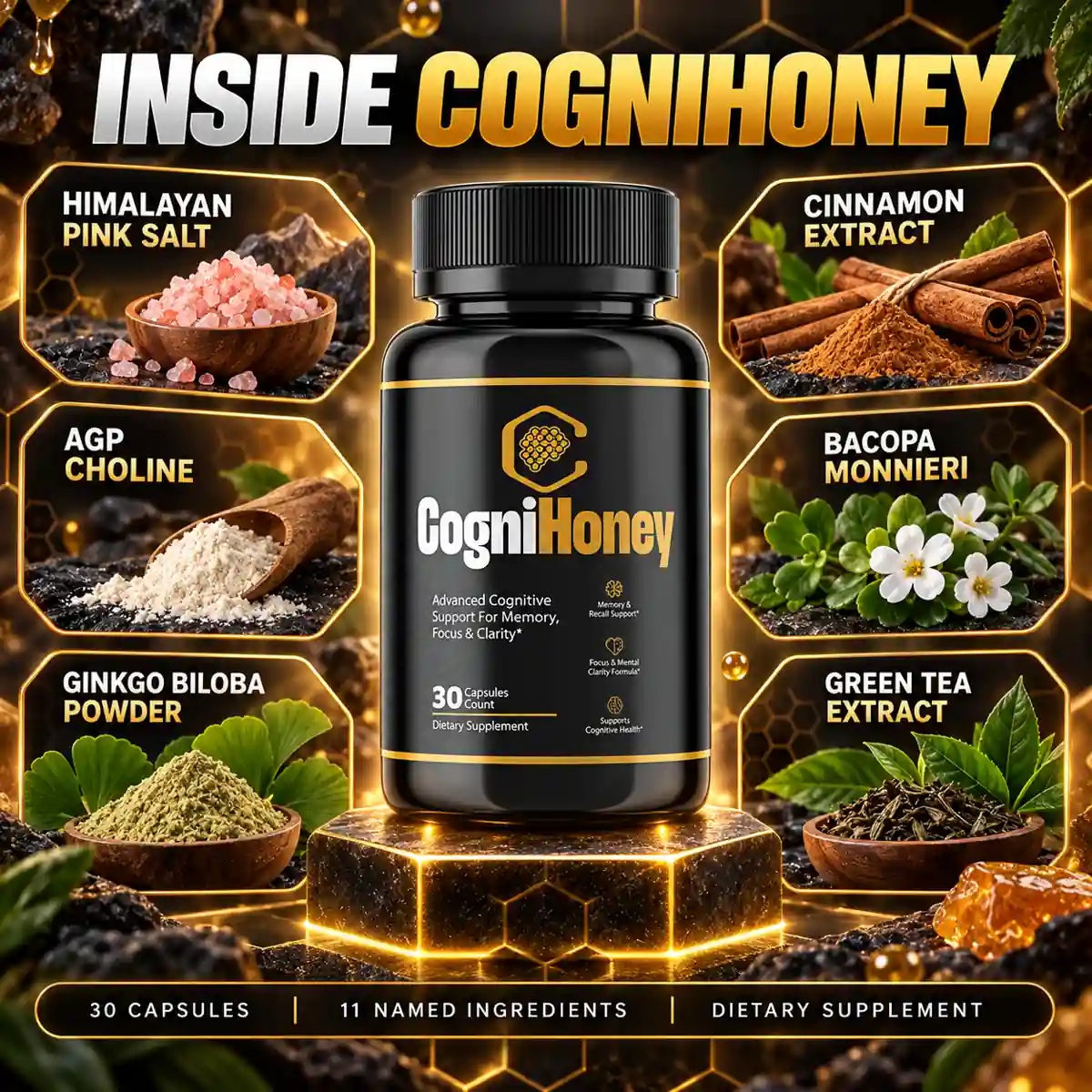
On the CogniHoney list, AGP choline is the third name, between cinnamon extract and bacopa, with no percentage and no amount. It is the formula’s choline source and one of the three names in its memory and focus core.
What the research lets you say is modest: in healthy young men, a single dose of a few hundred milligrams improved one of three attention tests an hour later. Whether the capsule carries an amount in that range is on the panel of the bottle you receive. The ingredients page places it beside the other ten names, and the how it works page explains the acetylcholine link at research strength.
If you already take a choline supplement, or a focus product that lists alpha-GPC or citicoline, add the amounts together once the panel shows the CogniHoney figure. The same ingredient under a different name is still the same ingredient, and it is easy to double up without noticing.
Questions to ask about the AGP choline line
- How many milligrams of AGP choline does a serving hold, against the 250 to 630 mg used in the healthy-adult studies?
- Do I already take alpha-GPC, citicoline or another choline product?
- Have I had a stroke, or been told my stroke risk is raised?
- Is my diet already rich in eggs, meat or fish?
The first answer is on the panel of the bottle you receive. The other three are yours, and each one changes how much the AGP choline line matters to you.
The stroke signal, in proportion
The stroke signal comes from an observational study of a prescription drug, and it proves nothing about a supplement capsule. It is still a finding worth knowing about if you have had a stroke or have been told your risk is raised, or if you take several choline products at once and the amounts add up.
AGP choline is not the only name on the list with a known interaction. CogniHoney also contains ginkgo, which may raise bleeding risk with blood thinners such as warfarin, and green tea extract, which has lowered blood levels of nadolol, atorvastatin and raloxifene in studies. The safety page lists each interaction.
Choline from food, and from a capsule
Most choline comes from food. Eggs are one of the richest everyday sources, and meat, fish, dairy and beans add more. The NIH fact sheet notes that many Americans fall short of the Adequate Intake, which is part of why choline appears on so many labels.
A capsule formula with several other ingredients is unlikely to supply more than a modest share of the 425 to 550 mg a day adults need, whatever its AGP choline amount turns out to be. That is not a criticism; it is a reason to treat the choline in CogniHoney as a top-up to a diet, not a replacement for one, and to count it once the panel shows the figure.
Sources cited in this post
- NIH Office of Dietary Supplements. Choline: Fact Sheet for Health Professionals. https://ods.od.nih.gov/factsheets/Choline-HealthProfessional/
- Kerksick CM. Acute Alpha-Glycerylphosphorylcholine Supplementation Enhances Cognitive Performance in Healthy Men. Nutrients. 2024;16(23):4240. PMID 39683633. https://pubmed.ncbi.nlm.nih.gov/39683633/
- Marcus L, Soileau J, Judge LW, Bellar D. Evaluation of the effects of two doses of alpha glycerylphosphorylcholine on physical and psychomotor performance. J Int Soc Sports Nutr. 2017;14:39. PMID 29042830. https://pubmed.ncbi.nlm.nih.gov/29042830/
- Lee G, Choi S, Chang J, Choi D, Son JS, Kim K, Kim SM, Jeong S, Park SM. Association of L-α Glycerylphosphorylcholine With Subsequent Stroke Risk After 10 Years. JAMA Netw Open. 2021;4(11):e2136008. PMID 34817582. https://pubmed.ncbi.nlm.nih.gov/34817582/
- Kim HK, Park S, Kim SW, Park ES, Hong JY, Hong I, Baek MS. Association between L-α glycerylphosphorylcholine use and delayed dementia conversion: A nationwide longitudinal study in South Korea. J Prev Alzheimers Dis. 2025;12(4):100059. PMID 40155153. https://pubmed.ncbi.nlm.nih.gov/40155153/
Keep reading about CogniHoney
See the whole CogniHoney formula
AGP choline is one of eleven names. Two capsules a day, fifteen days a bottle, and sixty days from purchase to change your mind.
$49 to $79 a bottle · two capsules a day, fifteen days a bottle · 60 days from purchase to change your mind
Order CogniHoney On The Official WebsiteLot COG-26/CO-7691 · checkout on the seller’s secure page